Monday, September 9, 2013

Christophe Josse Haute Couture Fall/ Winter 2013-2014

 
by David Pedroza, Editor in Chief
Photos Courtesy of Maison Christophe Josse
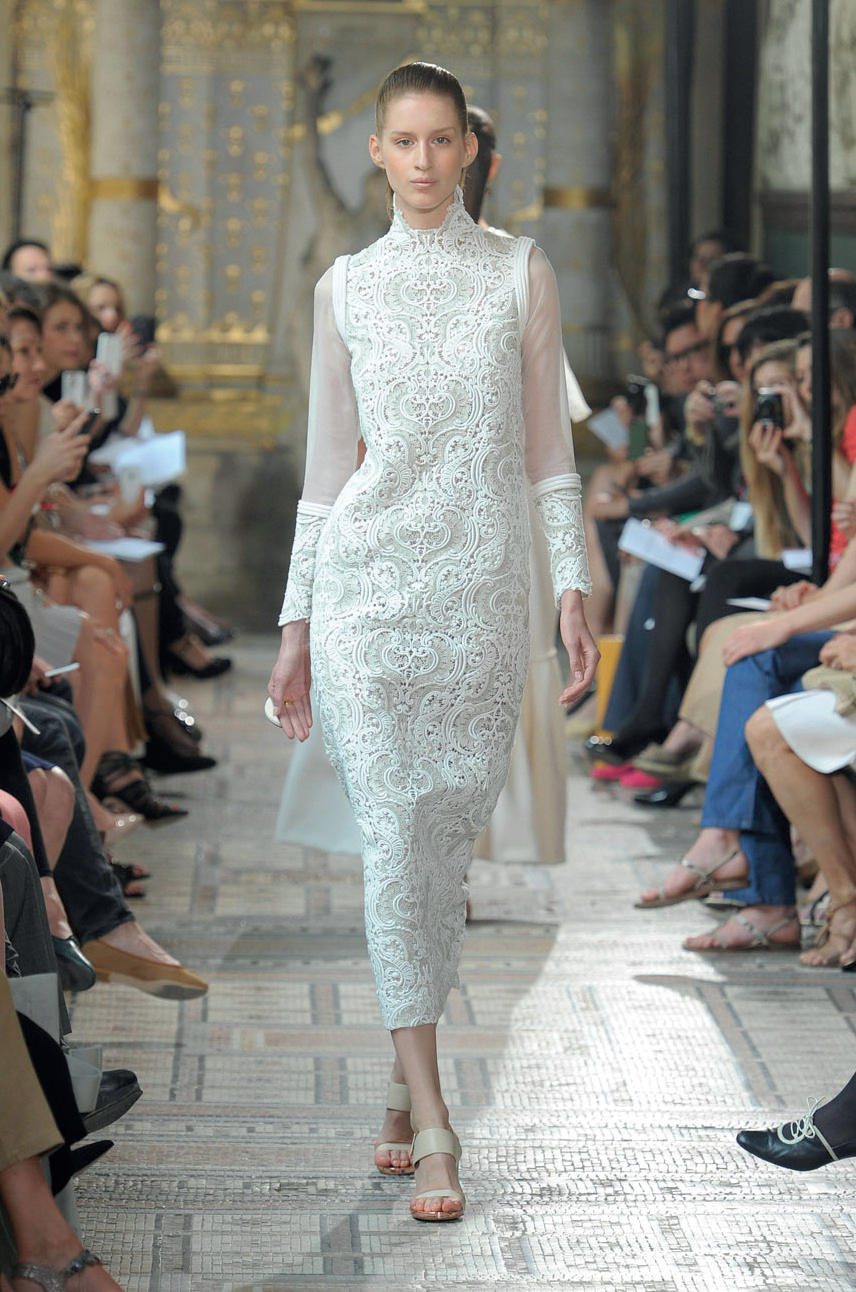
In the spirit of the season, Christophe Josse presented a collection of pure serenity and beauty. The tranquility and peacefulness of his Fall/ Winter 2013/2014 collection celebrated the exquisite craftsmanship of haute couture in a vision of white, alabaster, cream, and fleshy rose. Inspired by the folklore of near east Asia, the Urals of Russia, and the rich resources of haute couture, Mr. Josse has created a winter collection that is light, yet warm and elegant.  Although regal and dramatic in theme, the clothes themselves are stately, refined, yet casual.  The simplistic forms are matched to those of contemporary sculpture, and the textures are rich, thus no need to be emphasized by color, reminiscent of the work by contemporary artist Anselm Kiefer. Christophe Josse is a personal favorite, crating clothes that an  intellectual yet creative soul would gravitate towards.  The opening look, a wool crepe alabaster tunic paired with neoprene knickers, was an instant favorite, along with look number two, a guipure lace dress that captured a spiritually pure energy and perfection. Mr. Josse has refined his image and softened his hand, making him one of the grande masters of Haute Couture.


Friday, July 12, 2013

Schiaparelli Haute Couture by Christian Lacroix


Christian Lacroix's sketch for Schiaparelli Haute Couture on Invite, Fall 2013.
 Photo by David Pedroza, for Master the Art of Style, 2013. 
By David Pedroza, Editor in Chief

Christian Lacroix was the highlight of the Fall 2013 Haute Couture Collections. His collaboration with the House of Schiaparelli was a triumph of its own, for both the designer and the storied house.  Elsa Schiaparelli has always been an inspiration to Mr. Lacroix when it came to designing his collections under his own name, so when it came to designing for the house that bared her name, it was a natural, creative force. Mr. Lacroix designed the collection without the aid of the archives, but solely on the spirit of the house and what Schiaparelli represented.  Presented in the Musée des Arts Décoratifs, the 18 piece collection was displayed on mannequins; some of the looks stood still on a shocking pink carpet, while others rotated on a mirrored platform.

The collection felt very Lacroix, while still, there were so many Elsa Schiaparelli signatures. It is easy to say that Elsa Schiaparelli deeply influenced fashion, with surrealism, the modernist age, and art, which Christian Lacroix emphasized. Signatures such as the Iconic lobster were immortalized in an ultra-luxurious, sequin and beaded crimson accessory, and long-haired, goat fur, was used on boots and trims, to resemble Elsa’s love for monkey fur. Her love for the circus also played a role in the playful and youthful aesthetics of the collection, making the looks chic and regal without making it feel too serious. Playful details, such as oversized cargo pockets on a jacket, that created a flattering peplum, shocking pink fur poufs, and a color palate of saturated acid green, shocking pink (of course), crimson red, and vibrant magenta. The legendry Lacroix pouf silhouette was everywhere, from jabots on a green blouse, to skirts, and pockets. Stand out looks included a vibrant red jacket, festooned with black ribbon and jet embroideries, paired with pouf-faille pants; An oversized cargo-pocket cum peplum jacket; a “monkey fur” goat hair jacket with a regal navy faille ball skirt, adorned with an acid green bow; and an acid green mousseline silk gown.  Sadly, it was told the collection is not for sale (even to the most die-hard couture client), but the house of Schiaparelli did capture our attention and respect. We thank Elsa Schiaparelli and Christian Lacroix for making us dream!


                                                       Image source by ImaxTree Fall 2013

Wednesday, July 10, 2013

A Case for Alexis Mabille and Christophe Josse


Paris, July 2013
By Christine Suppes, Editor at Large
For more than one decade I have been attending the defiles of Christophe Josse, and I have always admired his elegance, lightness, and modernity. It seems now that his time has really come.  No longer does he take a backseat as an invited member.  And, Christophe Josse is not only a full fledged member of Haute Couture, his is one of the most sought after invitations in Paris.  I would even venture to say that the truly American fashion savvy girl not only knows his name but is aware of his fluid, feminine, streamlined style thanks to online stores such as ModeWalk.com.  I was somewhat taken aback that Josse showed an ivory only collection.  His use of color in his day suits and evening dresses are memorable.  But times change and so do we.
 
Christophe Josse for Torrente, Autumn 2003
photo courtesy of www.fashionlines.com
 
Tribute was paid to Yves Saint Laurent with Mr. Josse’s s version of the sarcophagus coat.


Very of the moment and Gatsby was the pleated drop waist gown, surely one of the most coveted pieces of the presentation.  In fact we saw a lot of the drop waist at Josse (and then the following day at Chanel).  This was a languid and eternal show, a pleasure experience and a clear imprint on our collective fashion conscience.


Then there is Alexis Mabille.  He is a more recent phenomenon of the eponymous bow.

Christine Suppes in Paris with Cameron Silver in Alexis Mabille Shirt.
 
It’s a bit of marketing bait, but who doesn’t love bows, especially during Couture Week?  Having said that, his show is also one of the hottest invitations of the week, and attracts the serious collectors who buy his exquisite gowns.  They’re pretty and flattering and never wrong.  What’s not to love? 


 Josse and Mabille were all over Paris during Couture Week, hitting every party and mingling with clients.  Imagine Karl Lagerfeld, Yves Saint Laurent or Jean Paul Gaultier ever mingling with clients.   Times certainly have changed!

                                                      Runway Images, by stylebistro.com

Wednesday, June 5, 2013

Maison Alexis Mabille Haute Couture


The new boutique and showroom at 34 Galerie Vivienne. Photo by Wilson McCord

Written by, David Pedroza, Editor in Chief
Photos and Art Direction by, Wilson McCord

A month before the news of being granted official title of Haute couture, by the Chambre Syndicale de la Haute Couture, I visited Alexis Mabille’s new store and showroom, in Paris. I have followed the work of Alexis Mabille, since the launch of his namesake house, back in 2005. He has evolved and retained his own identity since the beginning. Bows, sharp tailoring, uni-sex appeal, and a very French savior faire have all been trademarks in his collections. The launch of Impasse 13, was a mixture of pieces that were couture and pret-a-porter, designed to be worn by men or woman. Not until 2010, did Alexis Mabille start presenting his haute couture pieces on its own, giving it the well-deserved attention and showcasing the craft of his atelier. Since the beginning, the house had no intent on having an haute couture line, but the demands of the clients prove there was a strong desire for made-to-measure clothing with the Alexis Mabille touch.


A Fall 2012 haute couture sequin dress. Background: downstairs fitting room. Photos by Wilson McCord
At 34 Galerie Vivienne, stands the proud, intimate, and private Salon, with a small boutique on the ground floor curated with black and white pret-a-porter pieces. The 2nd floor, is the private, by appointment only, salon which houses haute couture collections. We are welcomed into the ground level boutique, which was purposely arranged to carry only black and white garments. It offers men and women the key staples to a perfect Alexis Mabille wardrobe.  I browse the selection of beautiful accessories, all in Alexis Mabille’s signature, the bow. Bow clutches, bow ties, earrings, necklaces, and pouches in every fabric and metal mixed into a selection of staples. These accessories easily add character to a soft Alexis Mabille smocking jacket or his signature, little-black-dress. We then meet with the communications director and Directrice of the house, Myrthe Mabille, sister-in-law of Alexis Mabille. She is a tall, thin, beautiful woman with a causal, Parisian flair (Mrythe has modeled in some of Alexis’s  shows) . She is warm and kind, and meets with us at the top floor salon, the new showroom for clients who wish to buy from the haute couture line. The soft lighting of the pink and gold printed walls, made after the walls of the Grande Palais, give a soft warm glow.  The space is small and intimate, like stepping into a private dressing room of an haute couture client.  We came on a transition time, when the haute couture collection for Fall 2013 was traveling to Dubai for a private presentation, then to Singapore for their couture fashion week.  The show room had couture pieces from previous collections, which was a treat for me to see almost every haute couture sampling from the beginning.  A small sampling of his Spring 2012 collection hung on a rack, saturated in beautiful bright and vivid acid colors. Beaded bustiers from previous seasons showed the detailed craftsmanship of the Cecile Henri Atelier, the house that produces superior embroideries for Mabille. Fabric swatches and sketches laid on a round table near the window, a design for a private client, which showed the close relationship Alexis Mabille has with his clients. As it was pointed out to me by Myrthe, the salon is a laboratory for client and designer to also create new concepts for custom orders, as well as to fulfill demi couture orders for a client who may not have such a large budget. Alexis Mabille wants to create a personal and one-of-a-kind experience with his clients, and will meet  with them one on one. Myrthe mentioned “clients always ask: Alexis, Alexis, can he come? And he makes time for each of them”. The salon also offers bridal options, and custom designs for a bride to be.
Left to Right: The many buttons on a Alexis Mabille smoking. Bow necklaces. Gwen Stefani wearing a Alexis Mabille Haute Couture hat from the Spring 2012 collection, on the cover of Harper's Bazaar. Alexis Mabille bow ties in Plisse Velvet. Photos by Wilson McCord
The embroidered and beaded bustiers from the Haute Couture collections. Photo by Wilson McCord.
One of my favorite Alexis Mabille Haute Couture pieces from Spring 2011. Photo by Wilson McCord
At 11 rue de Grenelle, Paris, is the address of the stand-alone, Alexis Mabille flag ship store. Our second stop just to see the first Alexis Mabille (many other locations to follow in other cities worldwide) which houses the ready-to-wear and accessories collections for both men and women.  The store reflects a clean and modern vibe, perfect back drop for the flamboyant and chic clothes that have a fun and casual spirit. The walls are adorned with large mirrors (Alexis collects vintage mirrors) with a color palette of soft pink, and of course, black and white. It is the perfect vision for an Alexis Mabille boutique, modern, yet youthful and playful.  Alexis Mabille has established himself as the darling of Paris, and has set his mark in ready to wear and haute couture. He has won the hearts of a new generation, and a strong following that will carry him on to the future. 


Spring 2012 selection of vivid haute couture samples. Photo by Wilson McCord
 
The façade of the 11 rue de Grenelle Alexis Mabille Flagship store. Photo by Wilson McCord


Tuesday, April 23, 2013

Maison Hurel: The Art of Fabrics


Written by David Pedroza, Editor in Chief
Photos and Art Direction by Wilson McCord
Without its artisans, haute couture will cease to survive.  Since the initial start of haute couture and especially after the Second World War, haute couture has depended on the quality of its sources and the artisans that create the raw materials used in creating these special creations.  Although, these artisans are kept from the spot light, they must be appreciated and celebrated for their respected craft! One house in particular, which I had the privilege to visit, is Hurel.  Maison Hurel was incarnated in 1879 by Edmond Hurel as a embroidery house in Paris, France. Not until the 1940’s did Hurel included fabrics, or tissus,  making the house known for Lace, Tulle, and its Novelty fabrics.   The demand for novelty fabrics has grown among fashion houses, being its biggest service , and reserving embroideries mostly for haute couture.  Maison Hurel has a very impressive clientele list, which includes Grande Maisons of haute couture, such as Chanel and Valentino.  Other major houses include Saint Laurent, J. Mendel,  Jason Wu, Gucci, Tom Ford, Christophe Josse, and Roberto Cavali to name a few. 
In 2007, Maison Hurel was taken over by Benjamine Hurel, Granddaughter of the house’s founder Edmond Hurel. The 5th generation Hurel family is taking the company to a new direction, to usher the house in to a modern era without losing the integrity of the Metier d’art.  Madame Benjamine Hurel discussed how they are involved with reviving old techniques of fabric making and applying them to new, modern, designs. All Hurel fabrics are entirely made in France, for both ready-to-wear and Haute Couture.  Its embroidery is done at the company’s in-house-atelier, at Hurel’s Paris Head Quarters. Martin Hurel, Director of embroidery, he over sees the direction and development of embroidery designs, and works mostly with haute couture houses to create unique, modern, embroideries, using traditional embroidery techniques. Baptiste de Bermingham, son of Madame Hurel, is director of communications and sales, he is responsible in the distribution of Hurel fabrics, and works with fashion companies worldwide.

In its history, Maison Hurel has managed to create fabrics and embroideries for some stellar creations from some legendary designers.  Valentino’s “Fiesta” dress created in 1959, features red roses, draped in layers of silk tulle over a tulle bustier, all fabrics from Hurel.  This quality of tulle has continued to be produced by Hurel and used by Maison Valentino for their Haute Couture collections.   First Lady Jacqueline Kennedy wore one of the most famous dresses made for her to a dinner at Versailles, an ivory Ziberline gown, designed by Hubert de Givenchy in 1961 and embroidered by hand, in a bouquet of flowers, by Maison Hurel.  Mrs. Kennedy wore the dress to the dinner in France, making a grand entrance in her unforgettable Haute Couture creation.  Most rec ently, Hurel created the scarlet red, bur n out silk velvet fabric, used to create the Jason Wu’s Gown, the first lady wore to President Obama’s Second Inaugural Ball. Their fabric innovations have been revered throughout time, as they continue to grow and discover new materials and reestablish old world techniques.


Left: FirstLady Jacqueline Kennedy Givenchy gown, Cica 1960's. Embroidery by Hurel. Photo by Metropolitan Museum of Art.
Center: Dior Haute Couture Spring 2013. Embroidery from Hurel. Photo by Stylebistro.com.
Right: Jason Wu's dress, worn by First lady, Michelle Obama. Fabric by Hurel. Phot by Stylebistro.com

At our visit to Masion Hurel, we were privileged to see the house in its entirety along with the archives. We also visited the atelier, where the embroideries are made, mostly for haute couture. The in-house artists are responsible for the surface design of all the fabrics, either exclusively designed for one designer, or designed to be sold for broader distributions.  Ninety -five percent of the fabrics developed at Hurel, are mostly used by luxury, ready-to-wear houses, while the rest, and embroideries are reserved especially for the haute couture house. Those fabrics designed for the haute couture, are usually designer for a certain designer, reserve a one of a kind aesthetic, and require more labor to manufacture.  The ready-to-wear fabrics have evolved to use modern, more efficient techniques, to create a larger yield, without reducing quality.  For example, at Hurel, looms that have been reserved for jacquard fabrics, have been used to create, 3 dimensional, textured velvets, in rayon and lurex.  Using the machines in new ways, has allowed Maison Hurel to create very lavished, new, luxury textiles that make fashion new, and inspire s designers to create new ideas. These ideas and concepts do come with the challenge of finding looms, or older looms, and the people that know how to use the equipment. Hurel has been adopting old, antiquated looms, in hopes of using them to re-develop old textiles, or use them to create new textiles. Some of these looms have not been in use since WWII, and require a skilled hand to manipulate and to create certain textiles.  One fabrics is Lace, a product in which Hurel specializes. Other specialized fabrics include; jacquards, velvets, taffeta, organza, tulle, and novelty fabrics. Lace with large repeats and designs have been in demand by designers in recent times, for bolder and richer effects.  Old  lace looms can create larger patterns, or repeats , but there are no artisans left who know how to use the looms or are willing to do the hand work, which pays very little, when much more money can be made doing a simpler job in other industries. When it comes to lace, even in the luxury sector, companies have turned to factories that imitate the hand work that used to be created by specialized artisans, using computer generated machines, and mass production. Lace with a larger pattern usually comes from the Lyon region of France, and has become more desirable for the bold patterns and larger repeats, but are often reserved for haute couture due to the high price to in manufacturing and its limited sources. Some lace patterns from the early 20th century, could not be re-made, since the technique has been lost over the years, so Hurel has been able to recreate these special laces using a modern embroidery technique, that gives the lace large, rich, 1 meter repeat. These textiles require special care, attention, and skill, which has become spares and hard to achieve.  The lost techniques of the golden age Meiter d’ art, makes it harder to produce these textiles.  Losing touch with the heritage of making haute couture textiles has forced this great House to creatively re-invent itself.  Maison Hurel is actively working on retaining a sense of heritage within its company.


Left: Flocked Tulle. Right: Lurex iridescent velvet.


Left: Guipure lace. Center: Sun-ray Pleated velvet, for haute couture.
Right: Raised textured fabric, using modern techniques to produce.


Left: Apstract printed gazar. Top-Right: Hand glued glitter on chiffon for Saint Laurent.
Button-Right: Lurex velvet, embossed to look like lizard skin.
 
Vintage print screens, on display at Hurel's studio.
Hurel Design and Embroidery Ateliers.

Hurel Artist a work with a new textile design
 
Haute Couture Lace, in a large repeat, developed by Maison Hurel.
 
The 3rd floor atelier is exclusively dedicated to the fine art of embroidery. This studio is respected for the skillful hands, and techniques used in haute couture embellishments and ornamentation.   Usually reserved for the Haute Couture houses, the embroidery atelier at Hurel, is one of the last houses that creates fine embroideries for haute couture. With clients such as Dior Haute Couture, Valentino Couture, Christophe Josse, and Gucci’s made-to-measure line, Premiere, they follow a strict standard of quality, and unique design.  All embroideries are done in house and all designs are either custom designed by the client or done by the Hurel design team.  With an average of 160 hours for each embroidery, this department works mostly with haute couture houses, and produces its creations with the tambour hook. The tambour hook, is an old, traditional, French tool used to attached ornamentation to fabric with thread. Rarely is the hand sewing needle used, except for large beads, crystals, fabric appliqués, or feather work.  Each embroidered design is either done by an in-house artist, or custom designed in collaboration with a designer. Maison Hurel, creates seasonal designs, which are presented to houses, a season prior, after a design has been purchased the design, the embroidery motif is reserved only for that house that has acquired it.  Maison Hurel never reproduces one design from  one house to another, and ensures the uniqueness of its design.  


Quality Controll: Hurel ensures all of their clients receive the finest quality.


Maison Hurel is a last of its kind in specializing in an art form that seems to be forgotten and not properly brought into the light. Hurel’s smart approach to retaining heritage and tradition, with keeping in mind the demands of the modern world, has proven that there is still a  passion for creating the essentials goods for quality clothing, and that there are still those who live to create beautiful works of art by hand. It is our duty to support artisans who put their love in soul into what they do the best!


The archives at Maison Hurel, every fabric created by the house.


Hurel's novelty laces, tulles, velvets, and flocked chiffons.

Monday, February 25, 2013

Haute Couture Report: Christophe Josse Spring 2013

Written by David Pedroza, Editor in Chief
The Tunic with Ceramic flowers, Photos by
Stephanie Kaufman.
In the past couple of seasons, Christophe Josse has created a image and a few signatures, that are entirely Josse! Mr. Josse goes from strength to strength each season, continuing his direction as the season before, moving forward with out trend, and creating clothes a woman can wear 20 years from now.  Taking inspiration from Tokyo's intricate streets, and silhouettes of the early 1970's for Spring 2013, Josse created a light and airy collection. The silhouettes where kept simple, feminine, and playful, and adorned in intricate linear intersections of satin, encrusted in Lyon Lace, or painstakingly woven, making this collection fresh, modern, and contemporary. Christophe Josse certainly makes clothes for an intellectual woman, and definitely for a modern woman who would appeal to his hand-blown, glass accessories and shoes that have been made to look like pearl or metal, making each piece light, artistic, and sensual to the touch. Stand out pieces include a simple organdy white tunic with ceramic white floral embellishment, and a white organdy gown with tiers of pleated ruffles. The fine fabrics such as Swiss cotton organdy, hand made Lyon Lace, and the finest leather-like silk satin were used in the making of each creations. These are the kind of  clothes in which one can live their lives in.
 

Haute Couture Report: Alexis Mabille Spring 2013

Writen by David Pedroza, Editor in Chief


The Alexis Mabille Couture Collection. Photo by Stephanie Kaufman
Now an official member of Fédération Française de la Couture, Alexis Mabille devoted his Spring 2013 haute couture collection to “craftsmanship”. This is one of the most important reasons a woman would buy haute couture, to acquire a piece of clothing that is made to perfection in her own measurements.  Mabille’s collection did speak to its audience; a lot of hand-work, and fine fabrics, with his whimsical and delicate aesthetic. The show started with girlish confections, of contemporary separates such as Lyon Lace embroidered tops, satin cigarette pants, and frilly organza skirts. The rest of the “exists” consisted of evening wear one can easily see on the red carpet. Just recently, Zoe Saldana turned out in look 16 from Mabille’s Spring collection, for the Oscars, a grey couture confection in tiers of organza that created an ombre look. Signature Alexis Mabille bows adorned several pieces, with our over powering the looks. Lace encrusted most designs, while strapless bustier gowns remained sexy, yet girlish. The Mabille smoking was paired with gowns or made into long dresses them selves, a staple in every Alexis Mabille collection.  Alexis Mabille haute couture collection was a perfect selection of sweet confections, like  magasin de patisserie, serving the prettiest creations any woman would love to wear and proving he is a true couturier.